October 5, 2026
Inside Our Wall Art Factory: Production Scale, Canvas Printing, and the People Who Build Every Order
A walk through our 7,600 m² OEM/ODM wall art factory in Jinhua: large-format canvas printing, framed-art lines, finished-goods storage, and the production team whose craft supports their families.
Written by the ChinaWallArt production team.
Wholesale buyers often meet a factory through a catalog. The catalog is the result. The work happens on a production floor in Jinhua, where canvas is printed, frames are built, and finished cartons wait for FOB Ningbo. This is that floor: the space, the equipment, and the people who run it.
Key takeaways
- ChinaWallArt manufactures OEM and ODM wall art from a 7,600+ m² facility in Jinhua, Zhejiang, with 80+ people, most of them on production.
- Large-format and flatbed printers, drying racks, and frame benches sit on the same site as finished-goods storage, so a program does not leave the factory between print and pack.
- About 60 production workers stretch canvas, cut wood, assemble frames, and finish pieces by hand. That work is how they earn a living and support their households.
State-of-the-Art Facilities & Production
The building is a modern industrial hall: high ceilings, concrete floors marked for traffic, and long runs of daylight along the windows. Printers are spaced so a roll or a rigid panel can move from the machine to a rack without crossing another job.
Canvas printing starts on wide-format equipment. An Epson printer runs continuous artwork from the roll, which is how a repeat order stays consistent from the first meter to the last. Flatbed printers beside it handle rigid panels and smaller formats that do not belong on a roll. Operators stay with the machine while color is laid down. A print is only as good as the person watching the first sheets.
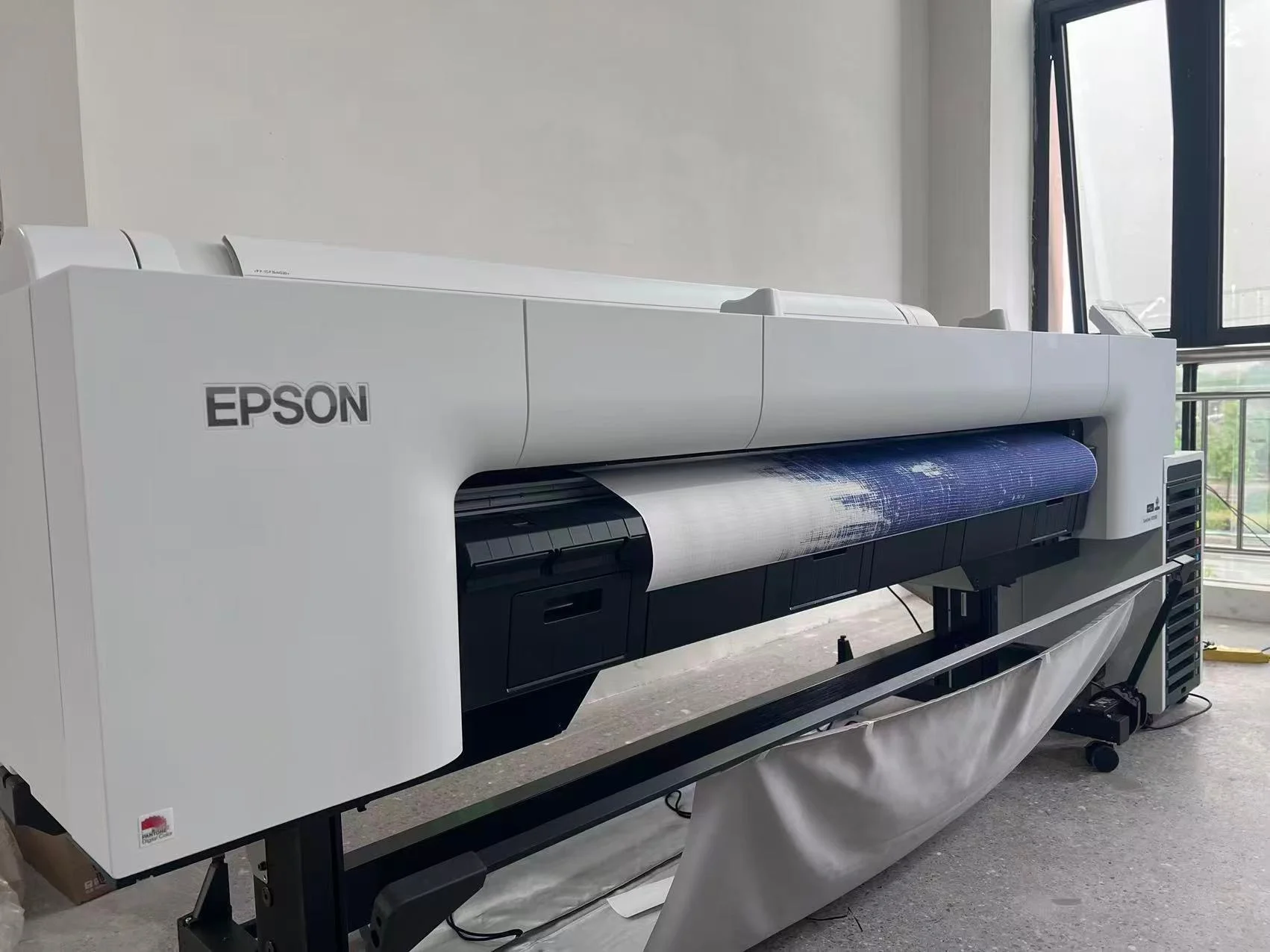
A wide-format Epson printer lays down canvas artwork in the Jinhua print room.
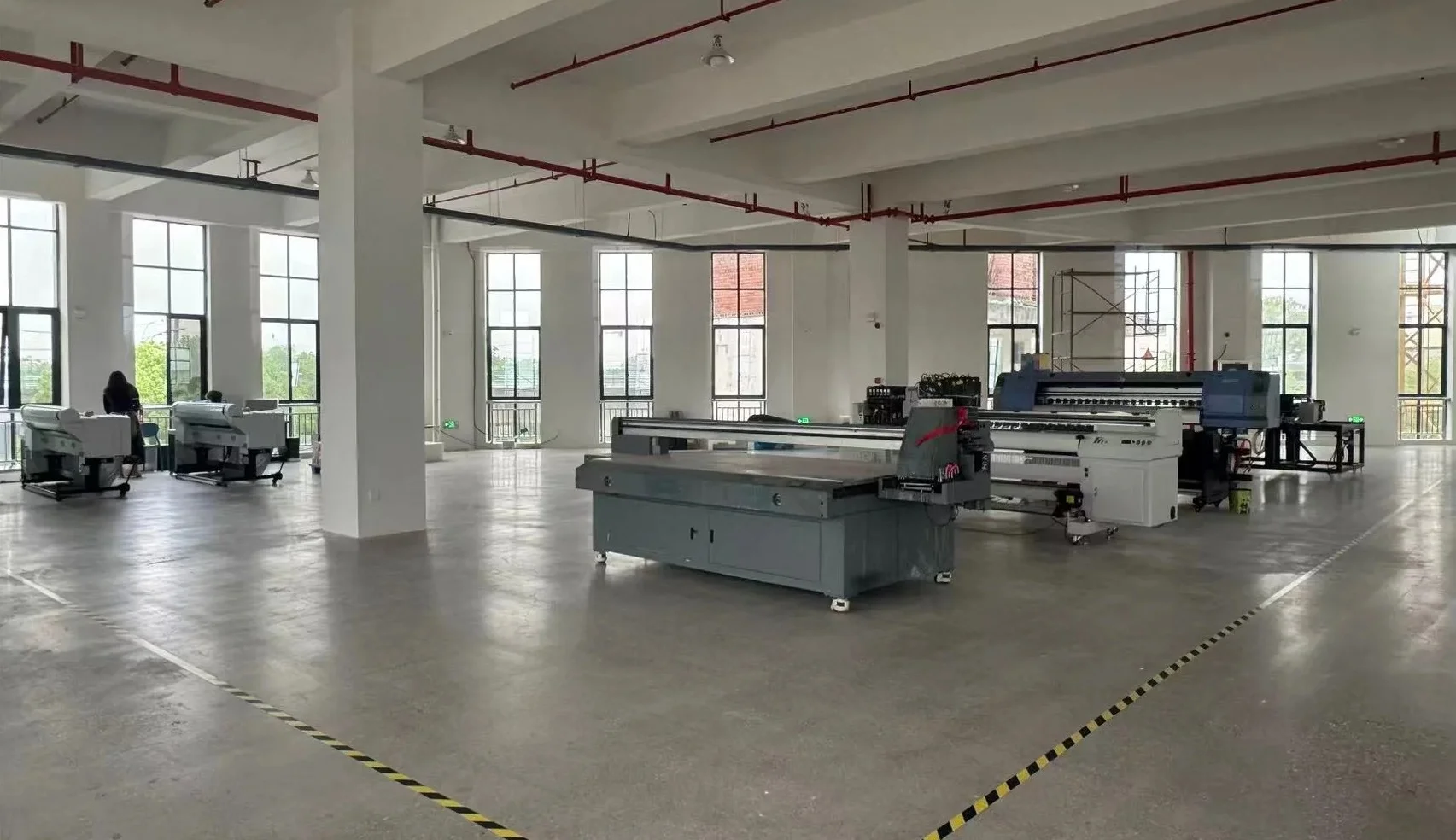
Print lines sit in an open production hall, with room to stage the next substrate beside each machine.
Printed boards then move onto multi-tier drying racks. Botanical panels, solid grounds, and full-bleed artwork cure in stacks before anyone frames or packs them. Rushing that step shows up later as scuffs in a container. The racks are how a busy week stays in order: each level is a job, and the job stays flat until it is ready for the next hand.
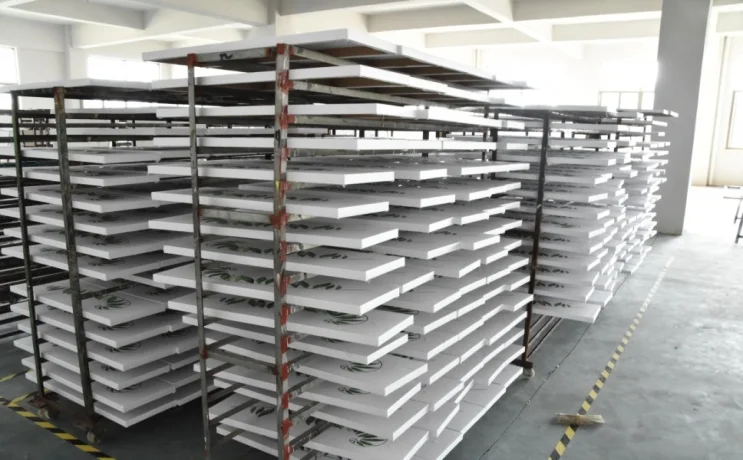
Finished prints rest on drying racks before framing, so the surface is stable before anyone handles it again.
OEM buyers send their own artwork. ODM buyers choose from programs our studio develops for North American and European assortments. Both paths use these same lines. A golden sample and the bulk order are made with the same printers, the same racks, and the same assembly benches.
Our Showroom & Product Exhibition
Global accounts rarely approve a wall-art program from a screenshot alone. Buyers who visit Jinhua review frames, canvas, and finished sizes in a dedicated display area before they lock a purchase order. Seeing the moulding depth and the print surface in the room is faster than another round of courier samples.
What leaves that conversation is staged in the finished-goods area. Palletized export cartons sit behind mesh gates, grouped and wrapped, with open floor in front of them so a forklift can pull a PO without breaking another stack. That open capacity is deliberate. Wall art is light compared with furniture, but it is awkward: cartons are large, corners are fragile, and a mixed container still has to leave in the sequence the forwarder expects.
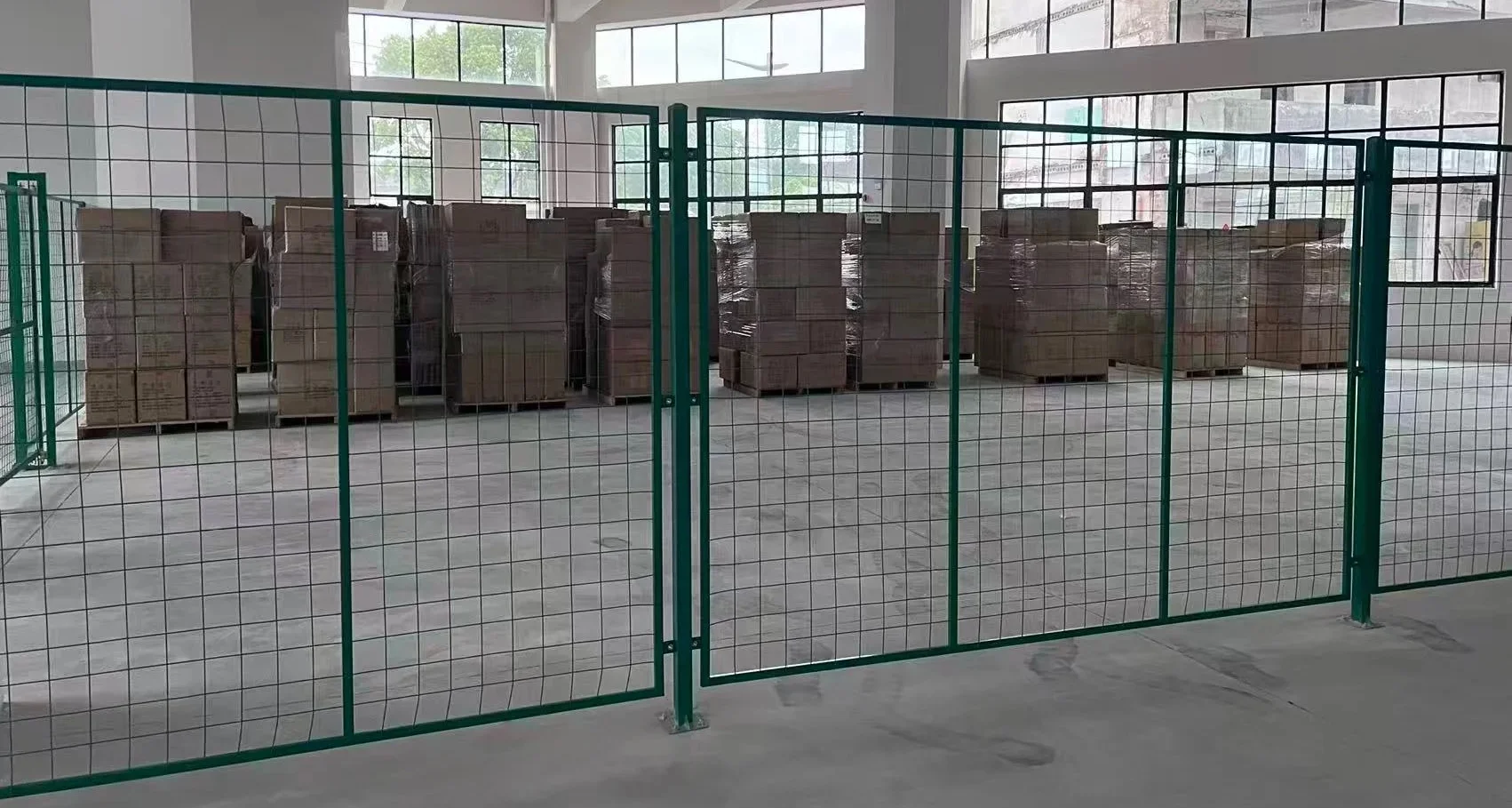
Export cartons wait on pallets in the finished-goods warehouse, ready for loading to Ningbo.
Shipments leave FOB Ningbo. LCL and full containers both move from this building. Third-party inspectors are welcome on the floor; the factory is BSCI audited, and visitor days can be booked against the production schedule.
The Heart of Our Factory: Hardworking Artisans & Skilled Workers
Equipment sets the capacity. People set the quality. About 60 of our colleagues work in production. They are not a backdrop for a factory tour. They are frame makers, printers, and finishers who come in to do a precise job and take wages home to their families.
Wood arrives as stickered pine. One worker cuts and prepares stretcher and frame stock at a bench surrounded by bundled lengths, gloves on, offcuts kept clear of the aisle. A square corner is a small thing until a retailer hangs fifty of them in a row. The person at that bench is the reason they match.
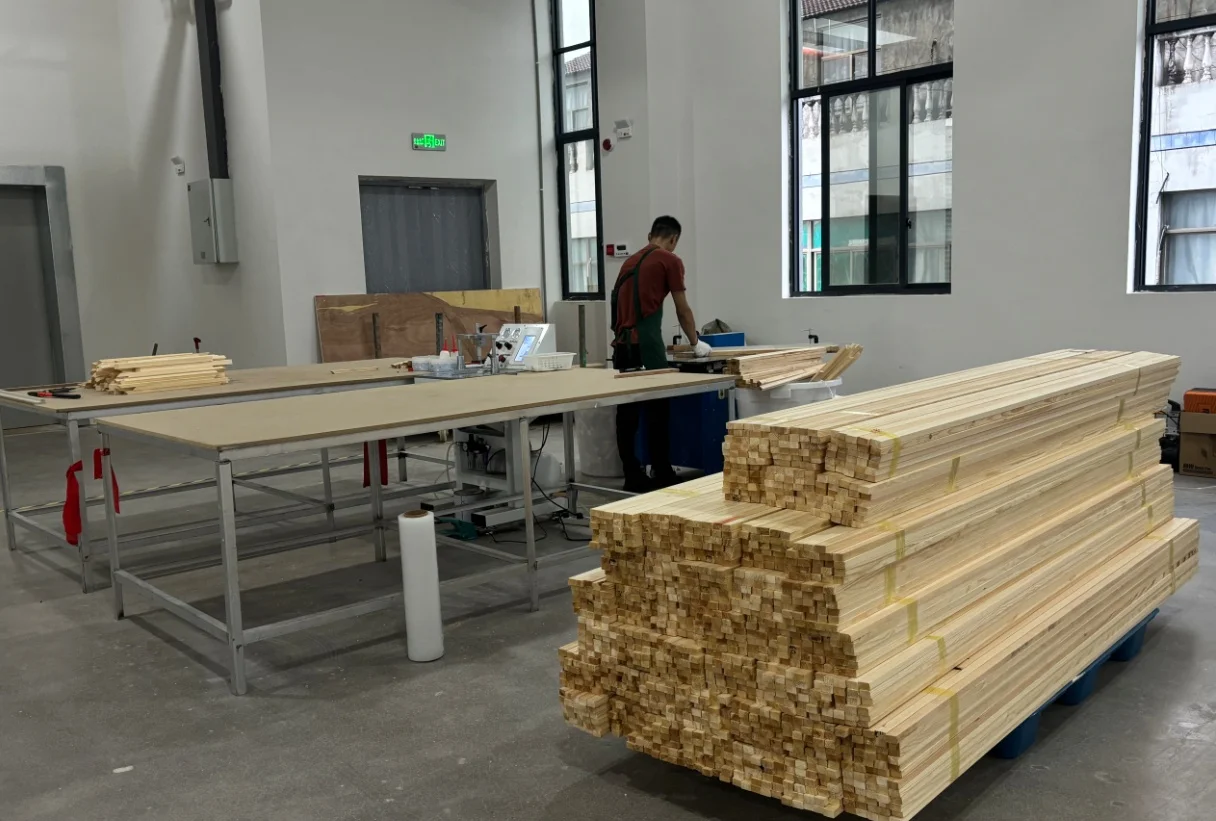
Frame stock is cut and prepared by hand before it ever meets a canvas.
Further down the hall, a long blue bench is an assembly line in the plain sense: people standing at intervals, each one fitting, checking, or wiping a framed piece before it moves on. The work is repetitive. It is also skilled. A stapled corner, a tight canvas, a clean rebate—these are learned in the hands, and they are how a mixed artwork order still looks like one program when it reaches a warehouse in Los Angeles or Rotterdam.
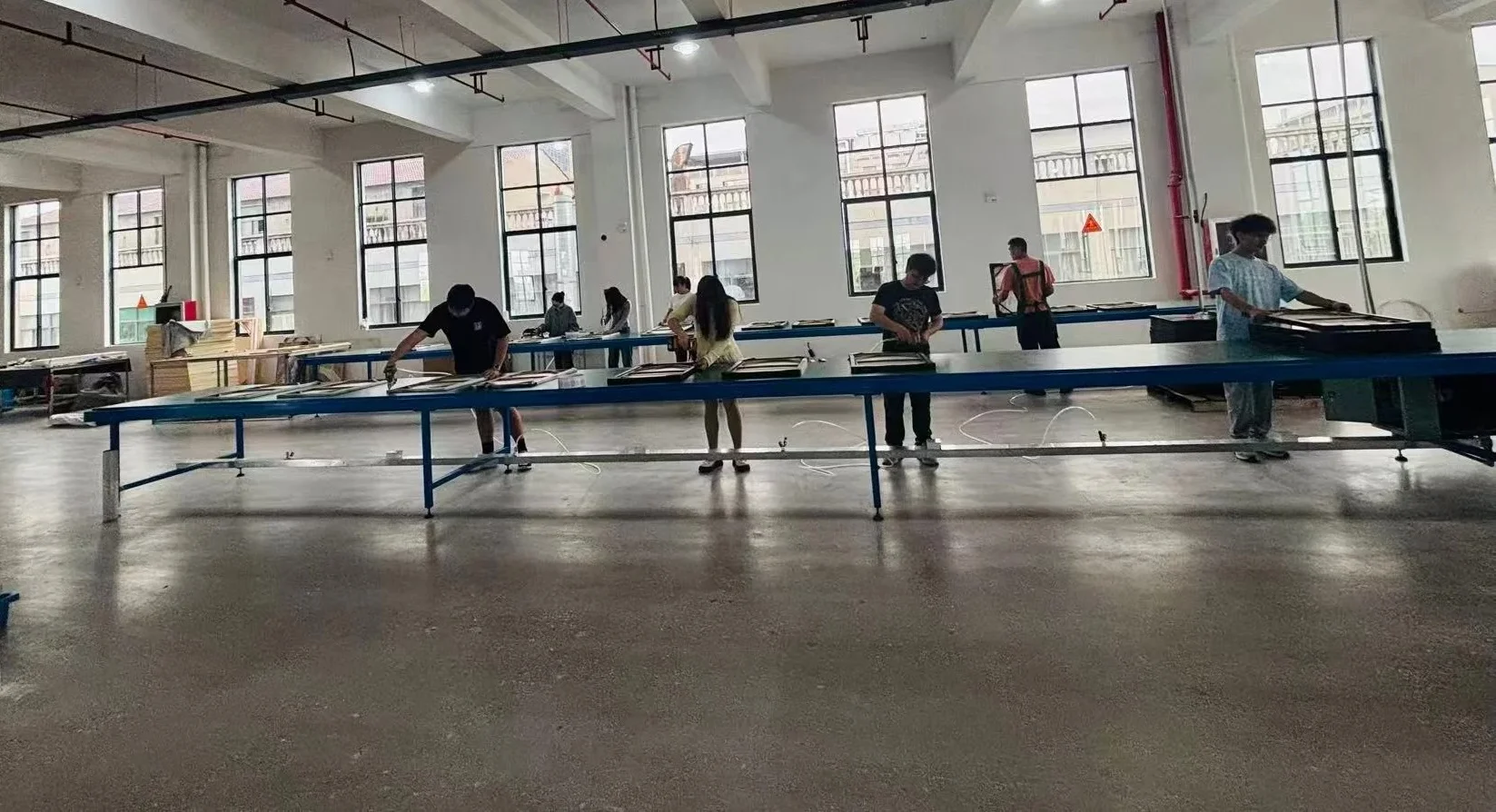
Assemblers work along one bench, each person responsible for a step the next person can trust.
At the finishing machine, two operators feed a printed sheet together. One guides the leading edge, the other supports the body of the piece so it does not crease. Nobody is performing for a camera. They are protecting a surface that a customer will stand close to. That attention is the craft. It is also a livelihood: steady export orders mean steady shifts, and steady shifts are how rent, school fees, and parents are covered.
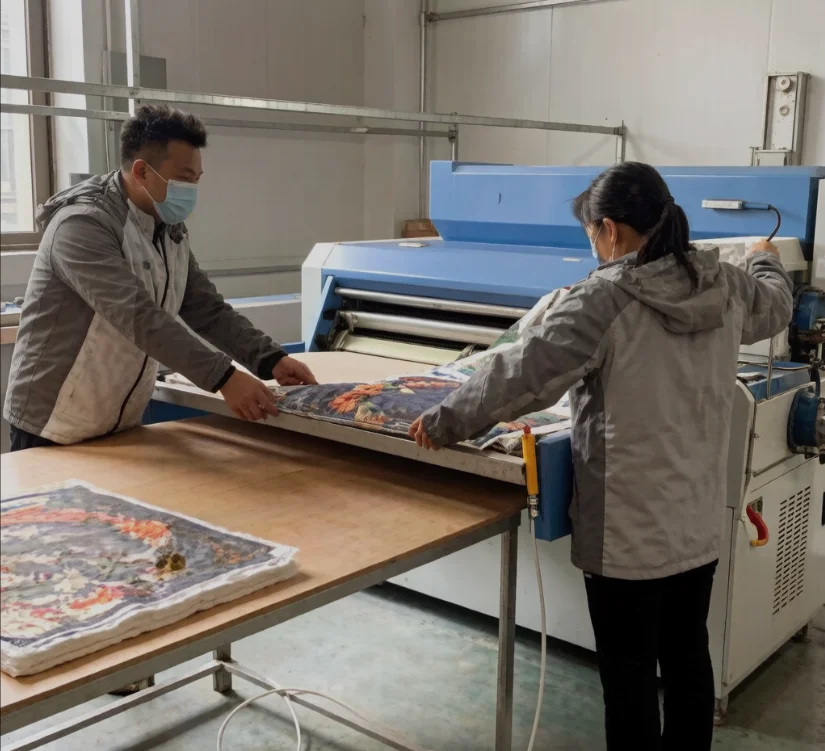
A pair of operators guides printed artwork through finishing so the sheet stays flat and unmarked.
We talk about artisan craftsmanship because the phrase is accurate here. Much of this work cannot be left to a machine and forgotten. Printing is automated. Stretching, joining, inspecting, and packing still depend on someone who has done the motion enough times to feel when it is wrong. Those colleagues take pride in that. The factory’s job is to keep the work safe, paid, and worth doing.
What a buyer can expect
A factory visit, a video walkthrough, or a catalog request all start from the same place. Tell us the channel, the sizes, and whether the artwork is yours or ours. We will show you the lines that will actually make it: print, frame, finish, and the warehouse those cartons leave from.
The people in these photographs will be the ones who build the order. That is the offer. Scale enough for a container. Hands careful enough for the piece on the end of it.